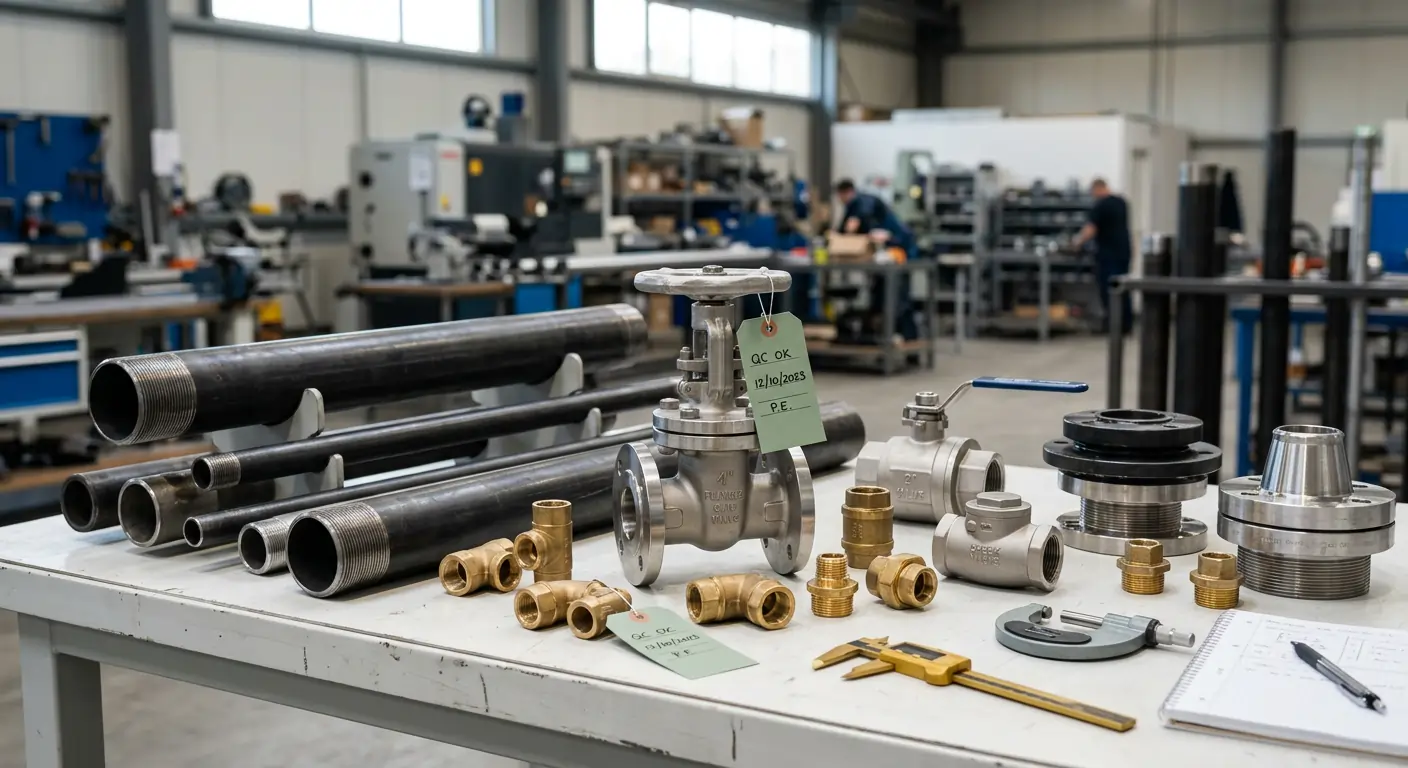
Selecting the wrong pipe, valve, or fitting for an oil and gas application doesn't just cause a maintenance headache — it can result in catastrophic failure, production loss, and serious safety incidents. Yet in practice, material selection decisions are often rushed, under-specified, or driven by lowest upfront cost rather than whole-life value. This guide provides a practical framework for getting it right.
Carbon Steel vs. Stainless Steel vs. Specialty Alloys
Carbon Steel (CS)
Carbon steel — typically API 5L Grade B, X42, X52, X60, or X65 for linepipe — is the workhorse of oil and gas piping systems. It offers high strength, wide availability, and relatively low cost. However, CS requires corrosion protection (coatings + CP for buried service; protective coatings or stainless overlays for process service). It is suitable for dry hydrocarbons and non-corrosive services.
Stainless Steel (SS)
316L and duplex stainless steels are specified where CS would suffer rapid corrosion — produced water, seawater injection, and low-pH process fluids. 316L provides good general corrosion resistance; duplex grades (2205, 2507) add high strength and resistance to chloride stress corrosion cracking, which is critical in Kuwait's saline environment.
Specialty Alloys (Inconel, Hastelloy)
For extreme service conditions — high-temperature sour gas, highly acidic process streams — nickel alloys like Inconel 625 or Hastelloy C-276 are specified. These materials offer exceptional corrosion resistance across a wide temperature range. Their high cost is justified only where the service environment would rapidly degrade lower-alloy materials.
Valve Selection: Matching Type to Function
- Gate Valves — isolation service; not suitable for throttling. ANSI Class 150–2500. Widely used in Kuwait upstream applications.
- Ball Valves — fast isolation, quarter-turn operation. Floating ball for ≤DN50; trunnion-mounted for larger sizes and high-pressure ratings.
- Globe Valves — throttling and flow control service. Higher pressure drop than gate or ball valves.
- Check Valves — prevention of reverse flow. Swing, tilting disc, or dual plate depending on flow profile and space constraints.
- Safety Relief Valves (SRVs) — pressure protection devices. Must be sized and set by a competent engineer; tested annually in Kuwait per KOC and HSE regulations.
- Control Valves — automated flow regulation. Sizing to ISA/IEC 60534 is essential to avoid cavitation or choked flow conditions.
Fittings: Standards and Specification
Pipe fittings — elbows, tees, reducers, flanges — must be selected to match the pipe material, pressure class, and end connection type. Key standards: ASME B16.9 for wrought butt-weld fittings; ASME B16.5 for pipe flanges (Classes 150 to 2500); ASME B16.11 for socket-weld and threaded fittings. Always verify the pressure-temperature rating at operating conditions, not just ambient.
Common Selection Mistakes to Avoid
- Specifying schedule (wall thickness) without checking maximum allowable operating pressure (MAOP).
- Using carbon steel in a wet H₂S service without selecting a sour-service (NACE MR0175) compliant material.
- Mismatching flange ratings between connected equipment — a Class 150 flange bolted to a Class 300 counterpart will fail at the lower rating.
- Selecting a valve with an elastomer seat incompatible with the process fluid (e.g., EPDM in hydrocarbon service).
- Ignoring thermal expansion in long piping runs — expansion loops or bellows joints are required.
Warah Energy supplies a full range of carbon steel, stainless steel, and specialty alloy pipes, valves, flanges, and fittings — all sourced from certified manufacturers and accompanied by full material traceability documentation for Kuwait's oil and gas projects.
Final Thought
Material selection is a technical discipline, not just a purchasing decision. Involving materials engineers and procurement specialists early — ideally at the P&ID and line list development stage — prevents costly substitutions during construction and reduces the risk of in-service failures. The right material, in the right specification, delivered on time, is the foundation of every successful piping project.
