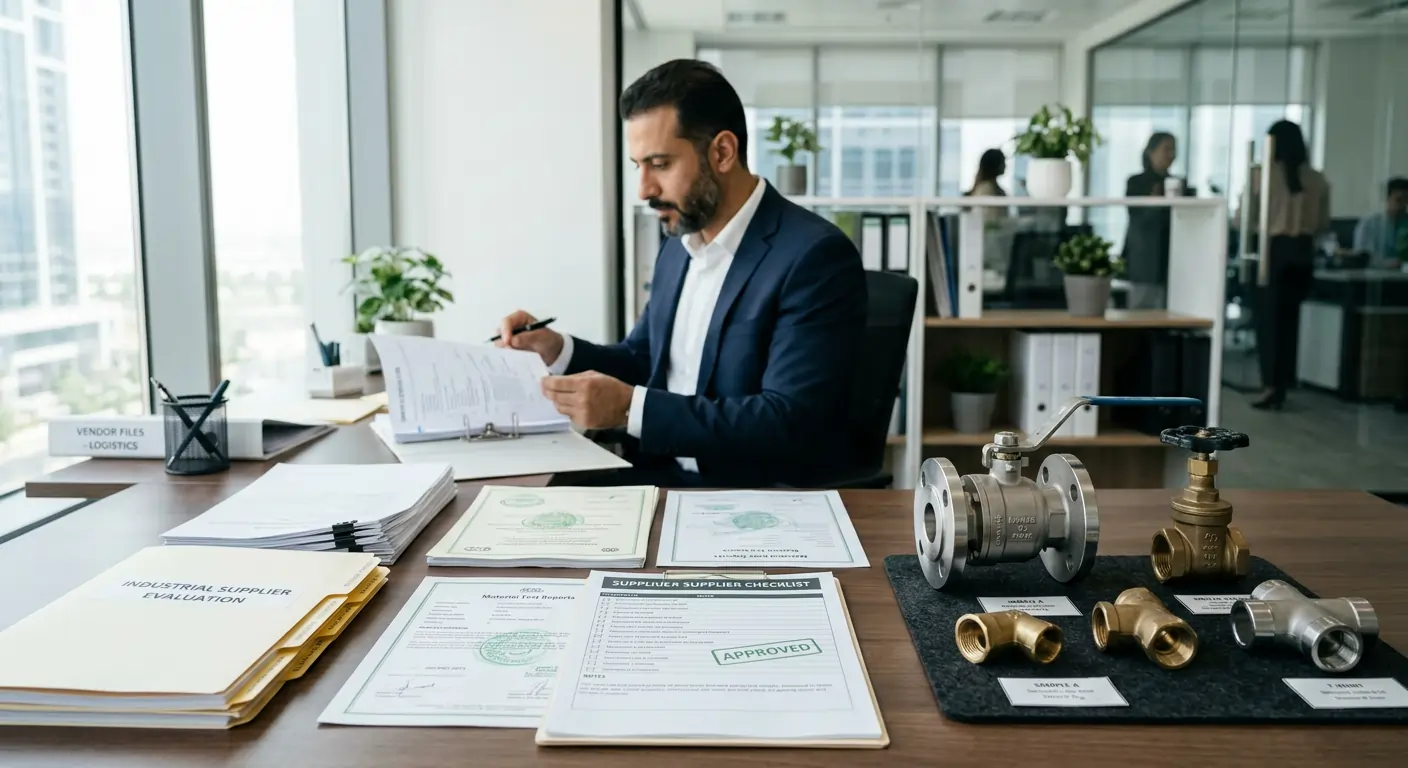
Kuwait's industrial market is served by hundreds of trading companies — ranging from large multinational distributors to small local agents. For project managers and procurement officers, choosing the wrong supplier is a risk with real consequences: delayed materials, non-conforming products, failed site inspections, and cost overruns. This guide sets out the eight criteria that distinguish reliable industrial suppliers from the rest.
8 Criteria for Evaluating Industrial Suppliers in Kuwait
1. Legal Registration and Commercial Background
Always verify that a supplier is properly registered with the Kuwait Ministry of Commerce and Industry. Check their commercial registration (CR), trade licence category, and — for government or semi-government projects — their classification with the Central Tenders Committee (CTC). Unregistered or incorrectly classified suppliers can disqualify your bid.
2. Approved Vendor Lists (AVL) Status
Many operators — KOC, KNPC, KIPIC — maintain Approved Vendor Lists for critical material categories. A supplier who appears on relevant AVLs has already been pre-qualified by the operator, dramatically reducing your technical and commercial risk. Always ask for AVL evidence for the specific material categories you need.
3. Manufacturer Authorisation and Direct Supply
Counterfeit and sub-standard materials are a documented problem in the Gulf region. Prioritise suppliers who hold valid manufacturer authorisations and can provide mill certificates, material test reports (MTRs), and third-party inspection certificates. A letter of authorisation from the OEM is strong evidence of a genuine supply relationship.
4. Technical Knowledge and Specification Reading
Your supplier's team should be able to read and interpret technical specifications, data sheets, and purchase order requirements — not simply offer the closest stocked alternative. Procurement specialists with engineering backgrounds provide much more reliable sourcing outcomes than purely commercial traders.
5. Track Record in Kuwait and the Region
Request references from past clients — ideally in the same sector and project type as yours. A supplier with a demonstrable track record of on-time delivery for oil & gas, construction, or government projects in Kuwait carries far less delivery risk than an untested vendor.
6. Logistics and Customs Capabilities
Material procurement doesn't end at order placement. Evaluate the supplier's ability to manage international freight, Kuwait customs clearance, inland transport, and last-mile delivery to remote or restricted-access sites. A supplier who controls the entire logistics chain reduces your coordination burden significantly.
7. Documentation and Quality Management
For regulated projects, material documentation — inspection test plans (ITPs), mill certs, ISO conformity declarations, coating inspection reports — is as important as the physical goods. Ensure your supplier has a documented quality management system and can provide a complete material dossier at delivery.
8. Financial Stability and Payment Terms
A supplier who cannot secure letters of credit or sustain pre-shipment financing may fail to fulfil orders when your project depends on it. Assess financial health through trade references and, for large-value orders, consider requesting bank guarantees or performance bonds.
Warah Energy meets all eight criteria above. We are Kuwait-registered, maintain manufacturer authorisations, hold AVL status with key operators, and manage the complete supply lifecycle from order to on-site delivery.
